Wednesday, September 2, 2020

Why is Eliot Named "Eliot"?


    There are two traditions in the history of Eliot regarding the naming of the town.  The first is that Eliot was named for a Robert Eliot, and the second tradition states that Eliot was named for the Reverend Dr. John Eliot of Boston.  So which of these is correct and who were these potential namesakes?  Unfortunately there is still no overwhelming evidence for either of these traditions but I will provide what information is available and share what I did 11 years ago in an attempt to solve this mystery.  I will also weigh in with my own opinion.

Who was Robert Eliot?  This is the first mention in any publication of a Robert Eliot for whom the Town of Eliot gets its name:


Leighton Genealogy, Tristram Frost Jordan 1885

This implies that this Robert Eliot Jr. graduate of Harvard, 1701 is the person for whom Eliot is named.  This was repeated in an April 1899 volume of Old Eliot submitted by another person named Jordan:

Old Eliot April 1899

I believe this J.F. Jordan got this fact from the Leighton Genealogy.  Robert Eliot Sr. had almost no connection to Kittery or Eliot.  He was a Portsmouth man.  Living in what would become Newcastle, NH.  His son Robert Eliot Jr., Harvard graduate, actually died at sea around 1715:

Harvard Quinquennial Catalogue 1880

While Robert Sr. may have been a man of importance in Portsmouth and Newcastle, his son who died in 1715 barely achieves any historical mention.  I do not find any compelling evidence that these men would have been held in any great esteem among inhabitants of the Upper Parish at the time of Eliot's Incorporation in 1810.  Or at least not enough to have them bestowed with the honor of naming the town after them.  Tristram Frost Jordan wrote two genealogical volumes covering his father's family and his mother's family (Leighton).  He knew all the old family names and probably decided that Eliot must have been named for this Robert Eliot who he found in his research of old families of the Piscataqua Plantations, whose daughters married into many promininent families including the Frosts and Leighton families of whom he was researching.


Second Meeting House at Crams Corner
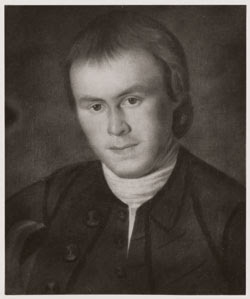
The second tradition of Eliot's naming states that the Reverend Dr. John Eliot of Boston promised to provide a bell for the meeting house if they would name the new town after him.  The meeting house in use at that time did not have a belfry, and so the bell was never provided.  Dr. Eliot was said to be a close friend of General Andrew Pepperell Fernald who was the person largely responsible for the movement to separate from the Town of Kittery.  He was chosen as the agent charged with presenting the petition for separation to the General Court in Boston.

John Eliot, D.D. 1780

So who was the Reverend Dr. John Eliot?  He was the son of the Reverend Andrew Eliot, who was the Congregational minister of the New North Church in Boston.  He succeeded his father as the pastor of the New North Church after his father's death in 1778.  In 1790 he helped found the Massachusetts Historical Society along with the Rev. Dr. Jeremy Belknap, formerly of Dover, NH, and a few other distinguished persons.   He married a Portsmouth, NH woman named Ann Treadwell and raised his family in Boston.  He died in 1813 just three years after the Incorporation of Eliot, Maine.  


Mass. Historical Society

Could the story of the promise of a bell be true?  It is hard to prove.  But it is possible.  In 2009 ahead of the Bicentennial celebration of the Incorporation of Eliot, I wrote to the Massachusetts Historical Society and asked if I could come to their library to read through Dr. Eliot's diary which was part of the Eliot papers left in the care of the MHS.  They offered to have two college interns perform the investigation.  I asked them to look for any reference to Kittery, Maine, the Incorporation, or Andrew P. Fernald in the 1809-1810 time period.  After a number of weeks they responded that the interns found no reference to the Incorporation of Eliot, and no reference to Andrew P. Fernald.  Their professional research staff double checked the intern's work and also found no references in Dr. Eliot's diary.  


I am unaware of the existence of any evidence that proves that either of these two traditions is true or false.  But I am more inclined to believe the story of the Rev. John Eliot and the gift of a bell.  I believe that Dr. Eliot would have been well informed of the happenings at the General Court regarding the petition of the Upper Parish to separate from Kittery.  He was a man who understood history and understood his time would soon be under the gaze of the historian.  I have no reason to doubt that Andrew P. Fernald was well acquainted with Dr. Eliot even if he does not appear in any of his diary entries.  They were both great men and contemporaries of one another and most likely socialized in the same circles when together in Boston.  Though, until more evidence appears, we must give equal consideration to both traditions for the naming of Eliot.  I will continue to seek answers to this question.


Tuesday, August 25, 2020

When was Eliot Settled?


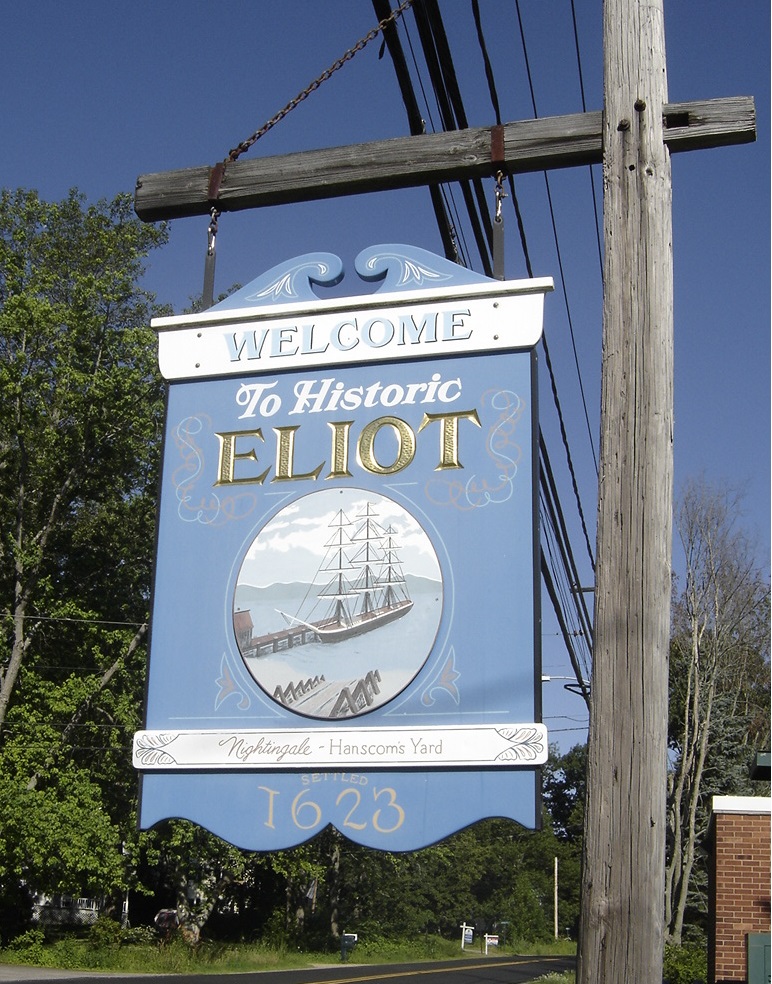
    When a town claims to be "settled" what exactly does that mean?  The standard for "settled" is permanent settlement.  This means one individual or family came to live in an area and there has been a permanent habitation within the boundaries of that area ever since.  So what about Eliot?  Well, since Eliot has only existed as a separate town since 1810, when we discuss the issue of when Eliot was "first settled", are we actually referring to when the town of Kittery was settled or when the first settlement occurred within the boundaries of modern Eliot?  Read on for the answer.  

So when was Kittery settled?  Kittery was incorporated as a town in 1647.  But first settlement can occur before incorporation.  What do the records say?


Everyone knows or should know that New Hampshire was first settled in 1623.  There are competing claims as to whether Portsmouth or, more specifically, modern Rye can claim the first settlement, or Dover.  Although there are compelling arguments that Edward Hilton arrived at Dover Point much later than 1623.  I will mostly stay out of those controversies for now.  But what was happening on the Maine side of the Piscataqua River at this time?  The only thing that was happening was Abenaki life.

  
Corn.  The Abenaki were experts at growing corn, and it didn't take long for the Hiltons to see that the Abenaki had already planted cornfields on the Eliot side of the river.  In fact William Hilton was growing corn in a field on the Eliot side of the river by 1630, at the location where Sandy Hill Farm is now located on River Road.  In 1632 Captain Walter Neale acting on behalf of Sir Ferdinando Gorges discovered William Hilton's cornfield and buildings on the Eliot side of the river and promptly destroyed the buildings and chased Hilton off the lands.  William Hilton was squatting on these lands that ultimately belonged to Sir Ferdinando Gorges after he and Captain John Mason divided their grants in 1629, with Mason getting all lands in what would become New Hampshire, and Gorges getting the Maine side of the Piscataqua.  Gorges then granted large blocks of land to his loyal agents including Thomas Cammock who received the lands where Hilton planted his corn in 1633.  Was the fact that William Hilton was planting corn in modern-day Eliot a sign that Eliot was "settled"?  My personal take on this is that this was a corn field, and perhaps outbuildings to store tools and maybe a place to get out of a sudden storm.  William Hilton had a wife and small children in 1630.  I find it hard to believe that they would live all alone on the Maine side of the river when a thriving and growing settlement existed across the river at Dover (Hilton's) Point where his brother's family lived.  In any case whatever was happening on these lands ceased in 1632.

Gorges Deed to Cammock

    Did Thomas Cammock then settle on this land in 1633?  By that time Cammock already had a large grant of land at Black Point in modern-day Scarborough and would end up settling on that grant until the end of his life.  In fact he sold his Piscataqua grant to John Trewogy on behalf of Alexander Shapleigh in January 1636 so it doesn't appear that Cammock was interested in settling on these lands where Hilton planted his corn.

    A little south of these lands was the grant of Thomas Wannerton.  Wannerton, in 1634 or 1635, invited his friend Nicholas Frost to come join him and live on a part of his land which Nicholas Frost promptly did.  This implies that Thomas Wannerton was already living on his land in 1634 or 1635 and was soon joined by his friend Nicholas Frost.  The only way we know that the year was 1634 or 1635 is from a deposition given in 1673 by Phillip Swadden who testified to knowing that Wannerton gave the land to Frost "about thyrty eight or thyrty nine years since" as no official deed was ever recorded for that land transfer.


After these original three 1633 grants to Cammock, Wannerton, and Henry Josselyn, more settlers came and the area which is now Eliot was truly settled.  So as far as when Eliot was "settled"?  I personally like the 1633 date.  That is when the ball really started rolling with settlement.  If we took a time machine back to 1633 we might encounter somebody living on these earliest grants, but I think by 1634 we definitely would encounter settlers here.  I have seen no evidence of any sort of settlement on the Maine side of the Piscataqua in 1623.  So maybe after we let Portsmouth and Dover have their 400th fun in 2023, we can come along 10 years later and have our own fun.


Saturday, August 22, 2020

Who was Dennis Downing?

    When researching Eliot's history one name that keeps coming up is "Dennis Downing".  The main reason is his was one of the three names listed as victims of the Ambush Rock Indian attack in 1697.  As the story goes, Major Charles Frost, Phebe Heard, wife of John Heard, and Dennis Downing were all struck down in that fateful ambush.  But we also read of the immigrant Dennis Downing who settled on part of the land which became known as the Bay Lands in 1650.  This immigrant Dennis Downing occupied about 30 acres of land which today makes up the Riverview development and Frost Tufts Park off the south side of Old Road.  Were these two the same Dennis Downing?  I will first see what I can find out about the earliest Dennis Downing who settled in the area of, what is today, Frost Tufts.

Location of Dennis Downing's homestead


    Various genealogy articles state that Dennis Downing lived in the "Spittlefields" section of London and married the widow Anne Daines in 1634.  Dennis and Anne along with two sons, John and Joshua came to New England in 1650.  His birth year is generally given as 1615 most likely to conform to his marriage date of 1634.  So Dennis was about 35 when he came to settle in Kittery and worked his trade as a blacksmith.  There are historical records that indicate that he had a residence at Crooked Lane in Kittery in addition to further up the river in what is now Eliot possibly due to his work as a blacksmith.  Dennis Downing acquired the property at what is now Frost Tufts Park in December 1650 in a deed from George Smith of Dover, NH who was authorized by John Newgrove to sell his lands to Dennis who was already a tenant on his land.  It is surmised that John Newgrove acquired this land from Henry Jocelyn who received the original grant of land that included all of the Bay Lands from his work on behalf of Captain John Mason. (See this link for more on the history of the Bay Lands.)

York Deeds Book 1 Folio 16


In 1652 Dennis Downing was one of the signers of the Submission to Massachusetts which placed Maine under the control of the Massachusetts Bay Colony. 

Mark of Dennis Downing
 

His estate was passed down to his son Joshua in 1676 (York Deeds Book 3 Folio 115) well before Dennis was dead.  Eventually when the Bay Lands were sold in 1699 to Joseph Hammond, John Fogg, Matthew and David Libbey and Stephen Tobey, there would be a land boundary dispute between Joseph Hammond and Joshua Downing.  A possible subject for a future post.


So is this Dennis Downing the same Dennis Downing that died at Ambush Rock in 1697?  The evidence shows that Dennis Downing born about 1615 was alive in 1690, but by 1698 he was deceased.

York Deeds Book 4 Folio 151

The immigrant Dennis Downing would have been 82 years old when the Ambush Rock attack occurred.  Major Charles Frost was 66 when he died in the same attack.  Phebe Heard was 27.  Would Dennis Downing at 82 years of age, have ridden on horseback from his homestead near the Piscataqua River to attend church services in the Unity Parish, modern day South Berwick?  Another clue presents itself in the following:

Old Eliot Vol 1 Page 84

Lyman Hammond's estate included most of the land in what today is the Eliot Boat Basin, or "Dead Duck Inn".  This is nowhere near the homestead of the immigrant Dennis Downing.  There is a mention of a 1694 land grant to a "Dennis Downing Jr." of 40 acres at "Beaver Dam":

Old Eliot Vol 4 Page 75

This would seem to imply that there was a younger Dennis Downing.  Perhaps a son or grandson?  I have not been able to link this land grant to the "estate of Mr. Lyman Hammond".  More research is needed.  I will update this post if new information comes to light.


The Story of Caleb Strong Frost and His Civil War Odyssey.

  On July 30, 1864 Caleb Strong Frost, aged 47, a mechanic, father of six and patriot from Eliot, died at the bottom of a crater in Petersbu...